
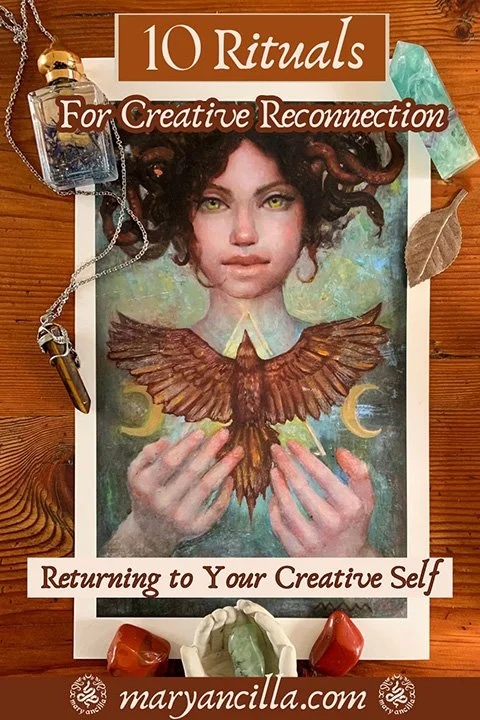
10 Rituals for Creative Reconnection: Returning to Your Creative Self
One of the challenges of living a creative life is that inspiration doesn't always arrive on command.
Most creatives eventually discover this. There are stretches when ideas seem abundant and the work moves forward almost of its own accord. Then there are other periods when attempting to make something feels more elusive. The desire to create remains, but beginning can feel surprisingly difficult.
Our culture tends to interpret this through the lens of productivity. If progress has slowed, the solution must be more discipline, more effort, or a better system.
Creativity rarely follows that logic.
The imagination responds to different conditions than those required to answer emails, complete tasks, or move through a checklist. It responds to attention and curiosity. To moments when the mind has enough space to notice something unexpected.
This may be one reason ritual appears so frequently in creative traditions throughout history.
A ritual doesn't exist to make us more efficient. Instead, it’s more of a threshold.
Unlike a routine, which helps us accomplish a particular task or goal, a ritual helps us enter something. It marks a transition from one state of attention to another. The actions themselves are often simple. What matters is the meaning and awareness brought to them.
For artists, writers, musicians, and makers, rituals can become a way of returning to the creative current when life has pulled us elsewhere.
The following practices are not intended as a formula. Nor are they in any type of order. Think of them as invitations. Try one. Ignore another. Adapt them to fit your own creative life.
1. Begin your day with an Empty Page

PAPERAGE Lined Journal Notebook
Before turning toward the demands of the day, create a morning ritual of spending a few minutes with a blank page. Draw, write, make marks, doodle, collect thoughts. Let the page become a place where attention gathers.
If you’re a person who likes lined journals, these Paperage notebooks are lovely (even though I personally never stay in the lines!). For unlined journals, I specifically enjoy art journals with thicker paper like the Beechmore Books brand for both writing and drawing or art journaling. It feels freer to me to use unlined paper and I am able to use light water based medium on the pages if I am inspired to do so.
2. Create a Small Space for Inspiration

Homedics Tabletop Water Fountain
Begin to gather small offerings from your surroundings-a feather carried by unknown paths, stones shaped by time, leaves that have completed their cycle, a photograph, —and place them together in a chosen space. A flower from the garden, a favorite book, fragments that seem to arrive for no reason-anything that you are drawn that feels sacred can be included. Bringing meaningful objects together creates a physical reminder of what nourishes the imagination. These objects can help to put you into a ritual state of mind by serving as reminders of meaning and intention, helping to mark the transition from everyday activity into ritual space.
3. Begin a Curiosity Walk Ritual
Choose a consistent time each week, such as Sunday evening, and return to it as a simple practice of attention. Walk through your neighborhood or visit a nearby path or area you don’t usually explore.
Move without a goal and let familiarity fall away. Notice what is growing, shifting, or overlooked—plants, trees, light, textures, and small details in the environment.
Listen closely to the surrounding sounds without trying to interpret them. Allow the place to register as it is.
At some point, let your imagination respond. Notice what story the place seems to suggest, even if only in fragments.
Return without needing conclusions. The practice is not about insight, but sustained attention and presence.
4. Keep a Symbol Journal

Leather Village Vintage Journal
Set aside time each week to record recurring symbols, animals, dreams, colors, or images that have captured your attention. Rather than searching for immediate answers, simply observe what continues to appear.
5.Weekly Creative Play Session
Dedicate a small block of time each week to making something with no intended outcome. Paint, sketch, collage, or experiment without deciding what the result should be. Returning regularly to creative play can help loosen the pressure to produce.
6. Keep a Beauty Collection
Create a dedicated place for collecting images, photographs, quotes, color palettes, textures, found objects, or anything else that catches your attention. Revisit the collection regularly and notice what themes begin to emerge.
7. Reading Ritual for Inspiration
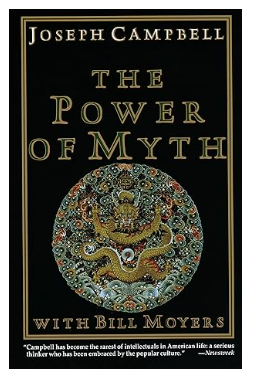
The Power of Myth by Joseph Campbell
Choose a few minutes each day or week to read material outside your usual interests. Folklore, mythology, poetry, natural history, and spiritual traditions all offer images and perspectives that can spark new creative directions.
8. Begin Creative Time in Silence
Before entering creative work, take a few minutes without stimulation—no music, no conversation, no devices. Let this become a repeated opening gesture that marks the shift into making.
9. Revisit Your Creative Archive
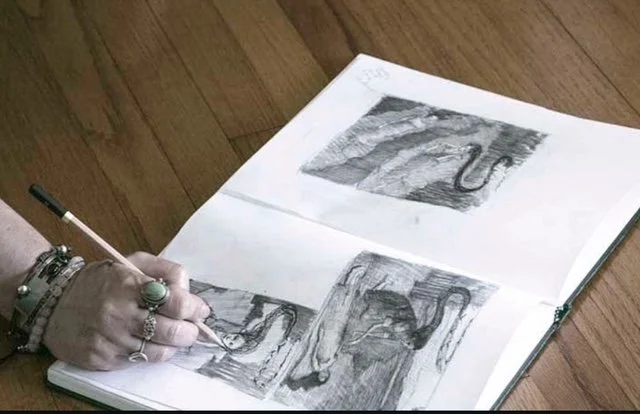
One of my old sketchbooks
At regular intervals, return to old sketchbooks, journals, unfinished works, and collections of ideas as a deliberate practice of reflection. Let this become a repeated moment of looking back at what has already begun forming, rather than something finished.
10. Honor Creative Rhythms
Creative life has rhythms. At the beginning of each season, month, or creative cycle, take time to reflect on what is emerging, what is complete, and what is asking for attention. Creative work rarely unfolds at a constant pace, and regular reflection can help you recognize patterns that are easy to miss while you are living them.
A Final Thought
Many of us think of creativity as something we must chase or recover when it feels distant.
Perhaps it is more accurate to think of it as a relationship.
Relationships are sustained through attention. They deepen through regular contact. And when they drift, they are restored in much the same way—through a willingness to show up again.
A ritual, at its heart, is simply a way of opening that door.
That is why rituals matter. They create opportunities to step back into conversation with the parts of ourselves that are often drowned out by schedules, responsibilities, and distraction.
If this idea resonates with you, you may also enjoy reading We Create to Return to Ourselves, where I explore why creativity is far more than self-expression or productivity. It is one of the ways we remember who we are beneath the noise of everyday life.
Sometimes the act of creating is not about making something new. Sometimes it’s about finding your way back to yourself.