
What Is Art Journaling?
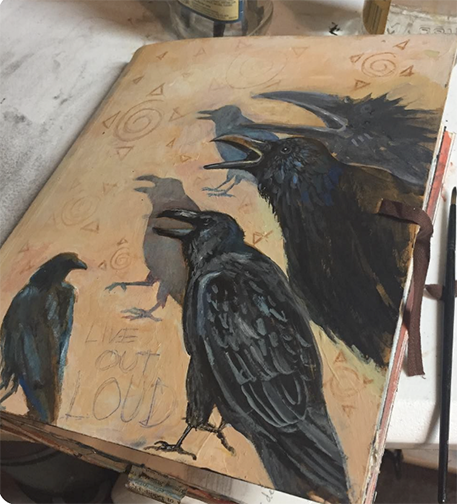
The cover of one of my art journals
What exactly is art journaling?
Art journaling, or visual journaling, is a mixed media practice that combines writing and art-making inside a book.
It’s a place where words and images begin talking to one another.
Sometimes the writing inspires the art.
Sometimes the art reveals something you can't put into words.
Sometimes a symbol appears that doesn't make sense until months—or even years—later.
Your journal becomes a place for introspection: to explore ideas, memories, and experiences through art making and writing.
Unfortunately, we don't live in a culture that gives us many opportunities for self reflection. Instead, we're encouraged to stay productive, stay busy, stay connected to everyone else, but not always connected to ourselves.
A visual journal gives us a place to ask:
What needs attention in my life?
This becomes a place where you can explore that question without needing to have an answer.
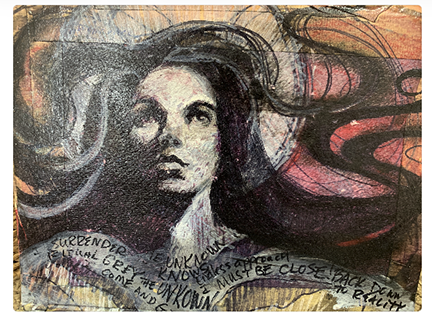
A page from one of my journals
What Makes an Art Journal Different?
An art journal can take many forms in one book. It might include writing, drawing, painting, collage, or all of them together.
It's actually more like a record of a life.
It's a place to collect dreams, symbols, conversations, memories, scraps of paper, poems, paint, photographs, questions, ticket stubs, leaves you picked up on a walk, sketches, quotes, colors, mistakes, discoveries, stories, etc.
Everything is welcome and belongs in a visual journey.
Treasures belong here.
Joy belongs here.
Confusion belongs here.
Grief belongs here. Secrets belong here.
Wonder belongs here.
Your journal is a reflection of you and your life, just as you are. Just like a diary, there is no pressure for you to become someone else.
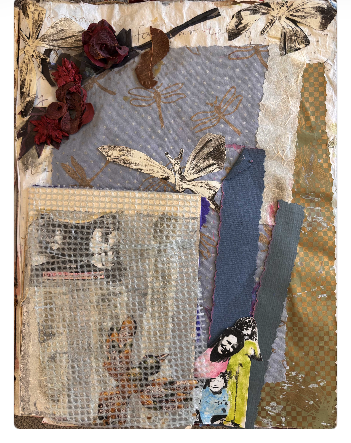
Another page from one of my journals, with a photocopy pic of my grandma, and mom and aunt as children.
Your journal simply asks you to be honest with yourself.
Over time, these books become layered, worn, stained, torn, painted over, glued back together, and filled with meaning.
I love that.
They're like living objects.
Even years after you finish them, they continue changing. Tape yellows. Certain inks fade. Images you painted over begin to reappear. Pages wrinkle. New meanings emerge.
Something interesting can also happen as well. When we put feelings, memories, and experiences onto a page, our brains have another way to process and make sense of what we're carrying. Art can give shape to emotions that are difficult to put into words, allowing us to see them, explore them, and sometimes understand them differently.
When we give an emotion a color, a shape, an image, or a few words, we take something that exists inside us and place it on the page.
We can then look at it from the outside.
The brain has something tangible to observe, reflect on, and make meaning from—sometimes allowing us to understand or process a feeling in a way that isn't possible when it's only inside our heads.
Something else I’ve found interesting is that In a way, they're a lot like us.
They're never really finished.
They're always becoming.
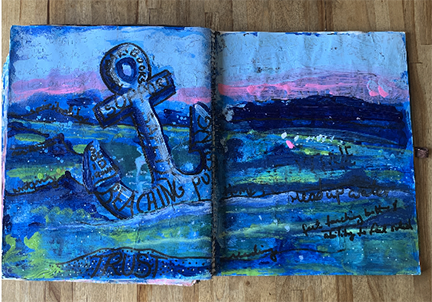
A two page spread from one of my journals
What Goes Into a Visual Journal?
There are no required materials and no particular way a page has to look.
You might begin with a sentence you've written, a photograph you found, or an image that caught your attention.
You might paint over an older page in a journal, or tear a piece of paper, add a handwritten word, draw a strange little shape, or glue down an image without knowing why you chose it.
You can use:
Paint and ink
Collage papers and found images
Photographs or copies of photographs
Handwritten words and writing
Drawings and sketches
Stamps and stencils
Magazine pages and old books
Fabric, tickets, receipts, or other ephemera
Symbols and personal imagery
Anything else that makes its way onto the page
The materials aren't really the point.
The point is what happens when you experiment and begin combining them.
A piece of text can change the meaning of an image.
A color can change the feeling of a word.
A symbol can lead you somewhere you didn't expect to go.
The page becomes a place where these things can interact.
You Don't Have to consider yourself an “Artist”
One of the things I love about visual journaling is that you don't have to consider yourself an “artist” to do it.
You don't have to know how to draw.
You don't need a particular style.
You don't need to make every page beautiful.
You can make a page that is messy, awkward, strange, unfinished, or completely different from anything you've made before.
That's part of the freedom.
A visual journal isn't a portfolio.
No one is grading the pages.
There is no right way to make one.
You can follow a prompt, begin with a word, respond to an image, or simply put something on the page and see what happens next.
The Role of Writing
Writing is an important part of visual journaling because it can give us a way into the page.
You might write about something that happened during your day. You might answer a question. You could write a memory, a dream, a list, a letter, stream of consciousness words, or a single sentence.
You don't have to show anyone what you've written.
Writing can just be a way of getting something out of your head and onto the page.
Then you can look at what you've written and notice what catches your attention.
Maybe it's one particular word, or a sentence you didn't expect to write.
Perhaps there's a recurring idea.
You can circle it, paint around it, collage over it, illustrate it, or use it as the starting point for the next layer.
This is where writing and visual expression begin to work together.
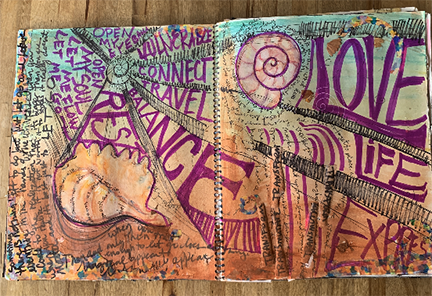
2 page spread from one of my journals
Following the Unexpected
A large part of visual journaling is learning to follow your curiosity.
You don't always have to know what something means before you put it on the page.
In fact, sometimes it can be more interesting when you don't.
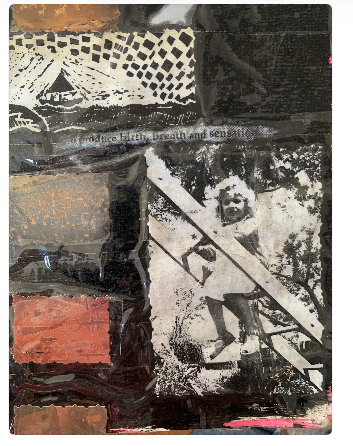
Collage page from my journal with a photocopy pic of my mom as a child
You might choose a particular color because you're drawn to it, or tear an image out of a magazine simply because something about it catches your attention.
You might draw a symbol you've never drawn before.
You can let the meaning develop later.
This kind of intuitive exploration can be surprisingly revealing because we don't always know consciously what we're looking for, and sometimes our art journal shows us.
A Place for the Things That Don't Have Words
There are experiences we can describe easily, and then there are experiences that are harder to explain, such as a feeling that is complicated or a memory that keeps returning. Maybe a change you haven't quite accepted or a question you don't know how to answer or something you sense but can't quite name.
Visual journaling gives these things another language.
A feeling can become a color, a memory can become an image.
A question can become a symbol.
A collection of words can become a collage.
You don't necessarily have to solve anything.
Sometimes seeing something outside yourself is enough to begin relating to it differently.
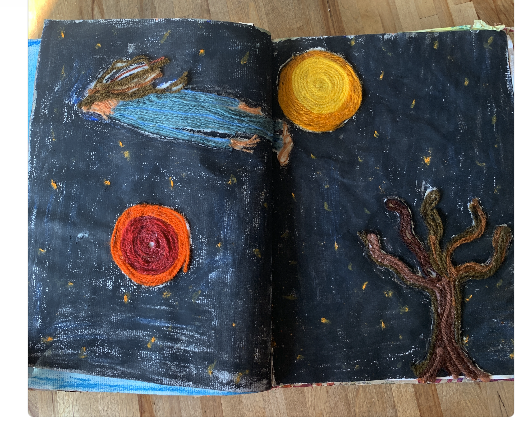
Journal spread about a dream
Your Journal Becomes a Record of You
One of the most meaningful things about keeping a visual journal is what happens over time.
You begin to see patterns or maybe certain colors appear again and again, or you see the same type of images return.
Words repeat and ideas evolve.
Things that once felt important become less important. Things you barely noticed become significant.
When you look back through older journals, you can see versions of yourself that you might otherwise have forgotten.
The pages become a record of how you were thinking, what you were noticing, what you were wondering about, and what you were moving through.
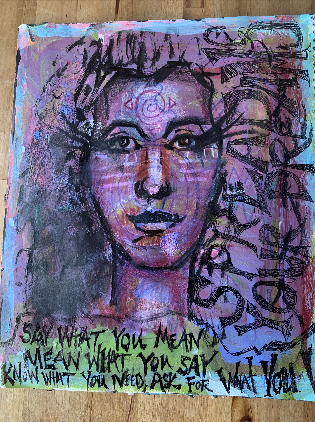
Another one of my art journal pages
Getting Started
Start an art journal with a book you don't feel afraid to use. Don't save the perfect sketchbook for when you're “good enough” to use it—choose something that makes you want to open it.
One important thing to keep in mind when choosing your journal is the weight of the paper. Very thin paper, such as copy paper, can buckle, bleed, and tear when you add paint or other wet materials. Thicker mixed media paper gives you more time to blend and layer paint and creates a much sturdier surface for working with a variety of materials.
If you choose a sketchbook, mixed media paper between 90–140 lb is a good choice because it can handle both wet and dry materials with less warping and tearing. There are many mixed media sketchbooks now that are easy to find and great to use, such as this Strathmore Mixed Media Journal, the Ohuhu Mix Media Pad Art Sketchbook, or a smaller one such as this one by Beechmore Books. They also make spiral-bound versions, but I prefer to avoid these for mixed media because paint and glue can build up on the spiral, making the pages difficult to turn.
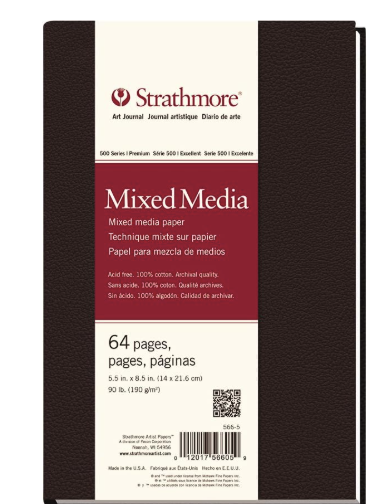
Strathmore Mixed Media book
There are also fancier ones nowadays, created by people who are known for their classes and books. You can try one such as this Dina Wakley Media Journal or this Ranger Dyan Reaveley's Dylusions Creative Journal.
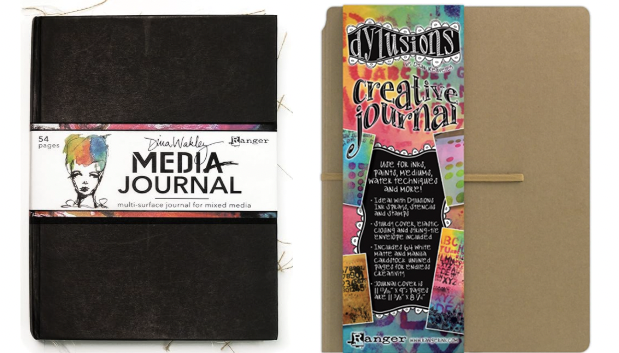
Dina Wakley Media Journal and Ranger Dyan Reaveley Creative Journal
People also like to use these ARTEZA watercolor paper journals. Because the paper is thick for watercolor, it is able to withstand other mixed media such as acrylic paint or inks.
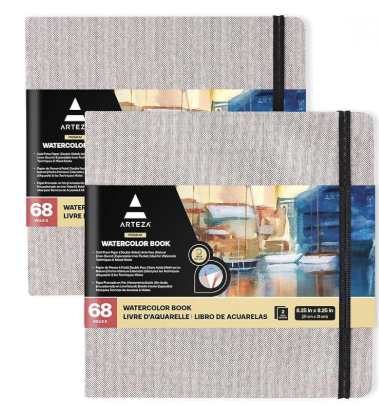
ARTEZA watercolor journal
You can also use a sketchbook you love with thinner paper, so don't fret if you already have one you want to use. You can strengthen the pages by gluing two sheets together, creating a sturdier surface for paint, collage, and other mixed media. Very wet techniques may still cause some buckling, but if you bear that in mind and pay attention not to use too much liquid with what you are doing, you can still work successfully this way. You can also use gesso to strengthen and seal the paper. Some people even tape their thin pages together and work on top of the tape.
Additionally, you can use an existing published book to create an altered journal and strengthen the pages in the same ways. I actually prefer using altered books nowadays because I love that they already have a layer of text or images to start journaling on top of. Just keep in mind that any method of strengthening the pages will add some bulk, so your journal may not close completely once you begin adding layers of paint and collage.
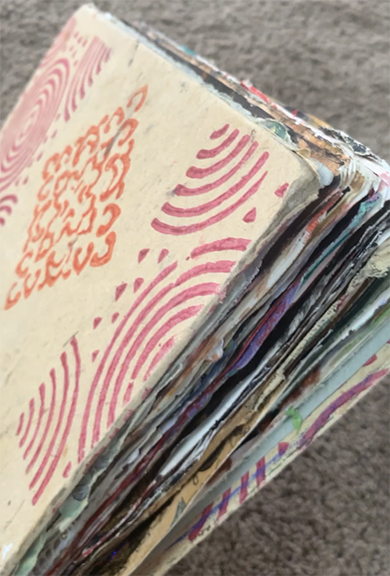
My art journal doesn’t close, but I don’t mind!
Once you have your journal, there is no prescribed way to begin. You might start with writing, a photograph, a color, a piece of collage, or an idea that catches your attention, then build the page layer by layer. You don't need to know what the finished page will look like.
Visual Journaling Is a Practice, Not a Product
One of the most freeing things about an art journal for me is that there is no finished product you have to achieve.
Some pages may become elaborate while others might contain only a few words and a wash of color.
Some of the art work you create may feel meaningful immediately. Others may make no sense at all.
That's okay.
The value of visual journaling isn't necessarily in what you end up with.
It's in the act of paying attention.
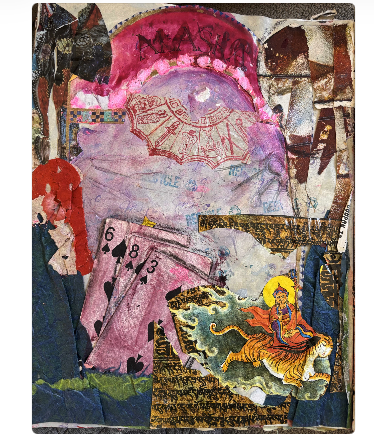
Another journal page
Taking a little time to notice what you're thinking, what you're feeling, what you're drawn to, what you're remembering, and what keeps asking for your attention.
The journal gives all of that somewhere to go.
Over time, those pages become something more than a collection of artwork.
They become a conversation with yourself.
A record of where you've been.
A place to explore where you're going or possibly a glimpse of something you didn't know was there.
They're never really finished. They're always becoming.
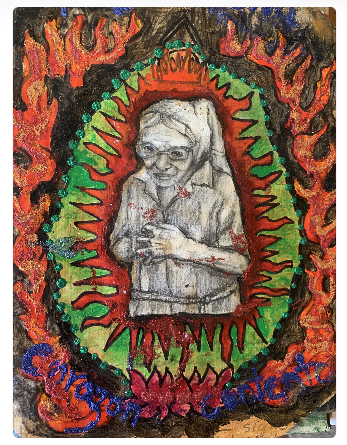
Journal page, drawing of my grandma
Join Me for Visual Journaling
If you'd like to experience this process for yourself, please join me at Wicked Wolf in Long Beach, every first Thursday of the month, for my new in person monthly visual journaling gatherings.
Every month we will explore a different theme or technique. Our first gathering, Conversations with Future Me, is Thursday, September 3 from 6:30-9 PM.
We'll explore writing, paint, collage, imagery, and symbolism through guided prompts and hands-on creative exercises.
September 3 • 6:30 PM-9:30 PM • $20
What to Bring
1–2 journals — one for your art journal and one for writing. If you prefer not to bring two journals, you can use loose sheets of paper for your writing instead. We’ll be writing while the first layer of paint in our art journals is drying, so you’ll need either a second journal or additional paper for writing. Also, your words are an important part of the process. Keeping a separate writing journal allows you to return to your thoughts and discoveries later, even as your art journal pages become layered with paint, collage, and imagery.
Optional: Collage materials, photographs, or personal images you'd like to use.
Optional: Pens or other favorite writing and drawing tools you love to work with
I'll provide the mixed media supplies we'll use during the workshop, including paint, collage materials, and other art-making supplies.
No art experience is necessary.