
I’ve been painting since the ’90s, and I’ve typically approached painting with a plan. I usually know what I want to create before I begin. But during an Intuition Painting session, I met a part of myself that had no interest in my plans, my good intentions, my vision of how I want a painting to look or feel or my attempts to make things look pretty.
She was fierce and unruly. She was unwilling to be softened. When I finally stopped trying to change her, she had something to tell me.
Her name was Rage Power.
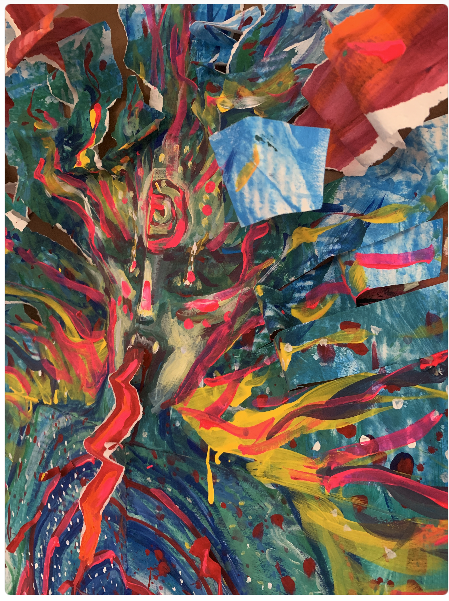
Rage Power
I discovered her through Intuition Painting, a process developed by Aviva Gold and later adapted and evolved by Montine Blank. Using simple materials like tempera paint and paper, we follow what emerges rather than work toward a predetermined image or finished product. During what’s called the Embodiment phase, we become one of the aspects of our painting, stepping into that part of the image and experiencing it from within.
I wasn’t sure what was going to happen in the painting…I’m never sure what’s going to happen during Intuition Painting. Once Rage Power appeared, I began to wonder what else might be waiting beneath the surface if I stopped trying to keep everything so carefully in line.
Meeting Rage Power
During the painting, a fierce-looking woman begins to take shape. As I work on her face, I keep trying to make her look more serene, perhaps a little more beautiful. I want to soften her expression, to make her more pleasing to look at.
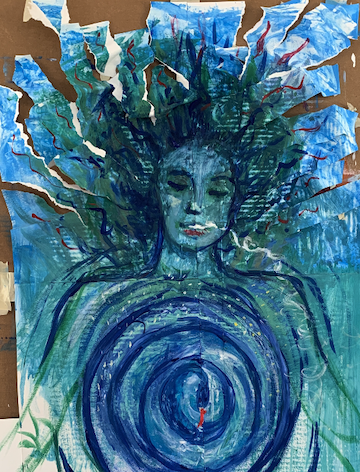
Trying to keep her face serene…
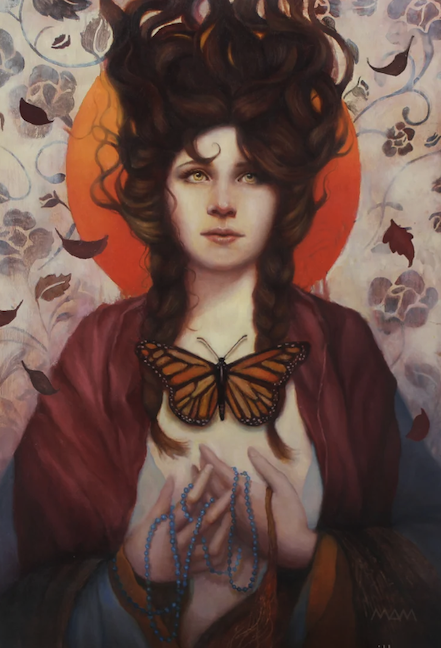
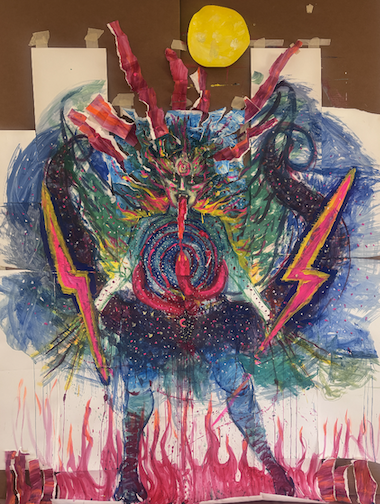
My painting “Metamorphosis”. I typically enjoy painting serene faces :D
But the painting isn’t coming together the way it wants to. I’m trying to force it into something it isn’t, rather than allowing it to become what it is.
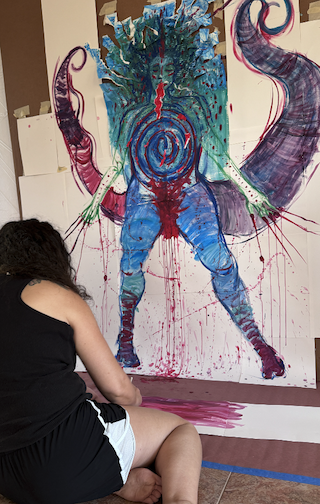
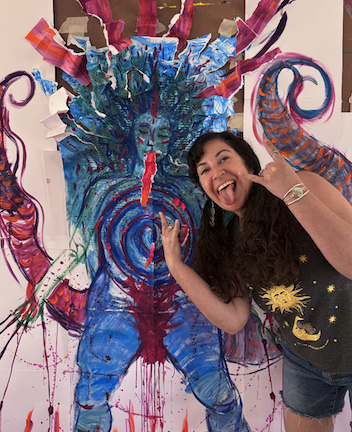
Still trying to keep her face serene, despite the other wild elements happening in the painting.
Eventually, I stop trying to change her expression and allow her fierceness to come through. Her face feels right when I do.
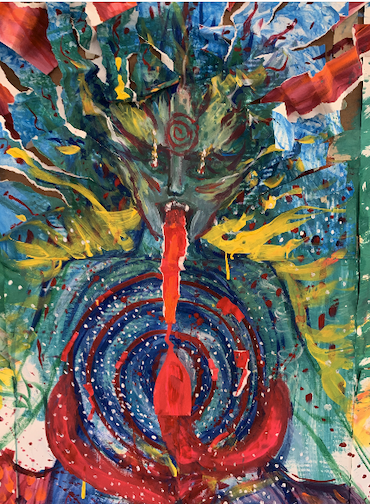
I finally let her out!
During the Embodiment phase of Intuition Painting, we become one of the aspects of our painting, stepping into that part of the image and experiencing it from within. When I step into this fierce woman, she introduces herself as Rage Power.
She has a lot to say.
She wants out. She wants to be wild, away from the routines and expectations that keep life contained. She wants open space, the desert, fire, dancing, and howling at the moon. She wants to find her wild woman tribe.
She also has very specific ideas about what needs to happen in the painting.
She wants a fierce face and wild hair. She wants lightning bolts and fire. She wants menstrual blood. There’s a snake in her womb that was originally facing down, but she wants it turned around to face up. She wants hooves for feet, two tails, a long red Kali-esque tongue, and horns.
She also wants me to tear the paper and reposition it. Not everything needs to stay where it started. The image itself has to change to accommodate what she wants.
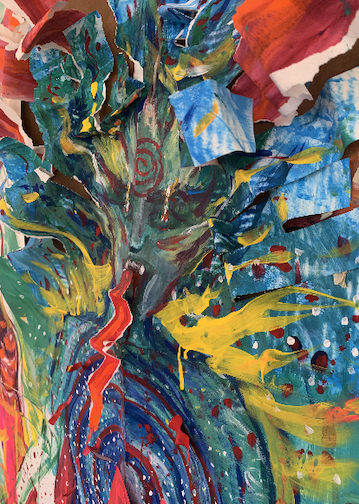
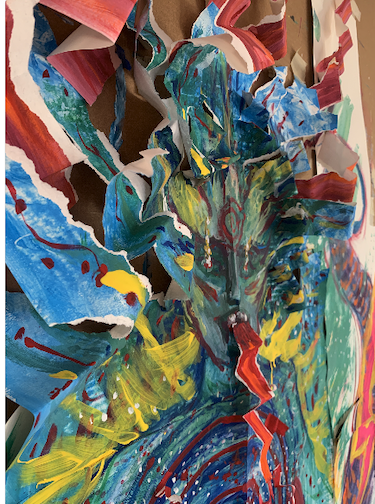
Rage Power isn’t asking me to make her pretty or palatable, but instead she wants her fierceness fully expressed, without being softened or cleaned up.
When I let her have what she wants, that’s when the painting starts to change again. The energy begins to feel different.
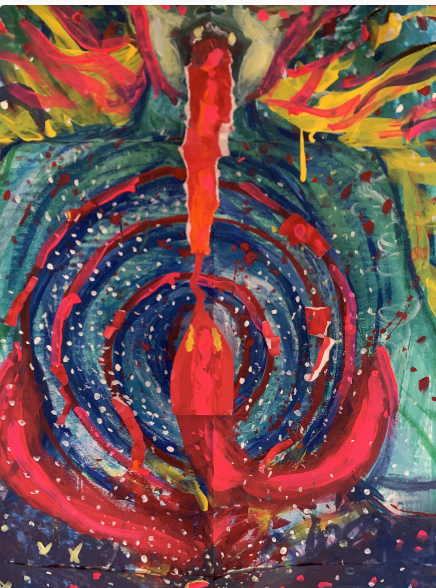
After the fierce face, wild hair, lightning bolts, blood, fire, and the now upward-facing snake has found it’s place, she asks for a full moon and stars. Then she wants the place where the menstrual blood appears, her vagina, to become the cosmos-vast and deep and connected to all life. Finally, she wants a cool, gentle rain falling softly all around her. She doesn’t ask for the moon, stars, and rain instead of the fierce imagery. She asks for them afterward, once the fierceness has been allowed to exist.
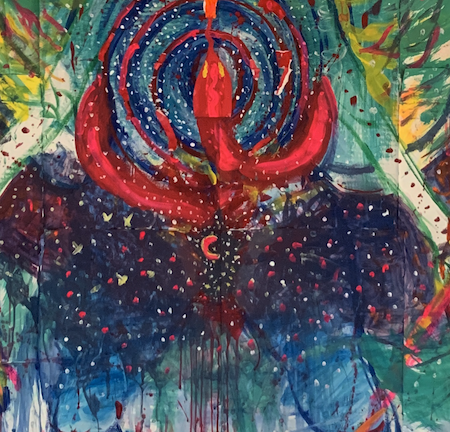
Her words, written in my journal, are direct:
“You're keeping me inside too long. You won't let me out. Let me out. Let me free.”
I realize that first, Rage Power needs to be seen as she is: fierce, elemental, unapologetic. Only then does the imagery open into something expansive and cosmic, with the softness of rain surrounding her.
I don’t want to impose a tidy meaning on the experience, but I can’t ignore the contrast. The gentle rain doesn’t erase the fire nor does adding the cosmos replace the blood. They all belong to her.
Rage Power seems to have room for all of it. The Wild Woman
Rage Power is a fierce and independent character. She isn’t particularly concerned with looking graceful or fitting anyone’s idea of what a woman should be.
There’s something liberating about her. She doesn’t seem interested in being good, agreeable, productive, or pretty. She wants to move, make noise, take up space, and follow her own instincts.
I recognize something in her desire to get away from the demands of everyday life. The familiar routines of work, responsibility, and city living can leave little room for the less polished parts of ourselves—the parts that want to roam, play, express anger, make a mess, or do something simply because it feels alive.
Rage Power gives those impulses a face and a voice.
Her name might sound intimidating, but I don’t experience her as a call to rage at other people. I experience her as a force that has been contained for too long. Her anger seems connected to all the energy that gets pushed aside when I try to be reasonable, composed, and in control.
She reminds me that there is a difference between being in control of myself and keeping parts of myself under lock and key.
And she is still here. I can’t say that one painting has suddenly changed how I live, or that I’ve figured out exactly what to do with everything she wants. But I know she has something to show me, and I don’t want to dismiss her simply because her message is inconvenient.
Burn the painting
Intuition Paintings aren’t necessarily meant to become finished works of art. They don’t have to be framed, hung on a wall, or sold. The point isn’t to create something polished for someone else to look at. It’s to follow the process and see what emerges.
The simple materials are part of that. Tempera paint and paper keep things uncomplicated and encourage a more immediate, childlike approach to making art. There’s less pressure to produce something precious or permanent.
After my experience with Rage Power, she requested to be burned.
So I burned the painting.
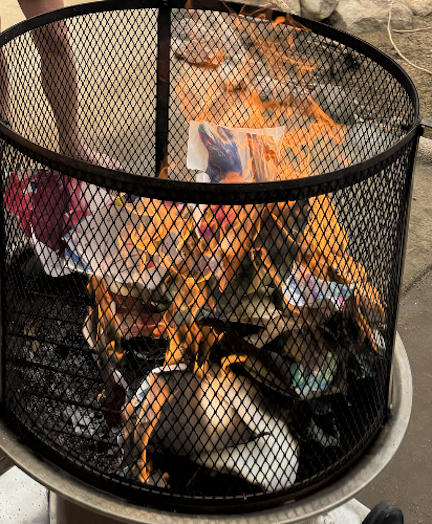
There was something fitting about letting the image go rather than turning it into another object to keep, evaluate, or make presentable. The experience had already happened. I didn’t need to preserve the painting to hold on to what I’d learned from it.
The image was temporary, but the encounter wasn’t. Rage Power had introduced herself, and I was left wondering how to make more room for the parts of myself she represents.
I don’t think everyone who meets a powerful image through Intuition Painting will have the same experience, and there’s no single meaning to uncover. What emerges is personal. For me, the encounter brought a question into focus: What might change if I gave my wilder self more room in my life?
Making Room for the Wild
You don’t have to meet a character called Rage Power to recognize the feeling of being contained by your own routines. Maybe you long for more adventure, more solitude, more creative freedom, or more opportunities to do things without worrying about how they look to other people.
Making room for your wilder side doesn’t have to mean abandoning your responsibilities or changing your entire life. It can begin with small choices that reconnect you with your instincts, your body, and the parts of yourself that don’t always get a say.
Here are five ways to begin.
1. Spend More Time in Nature
There’s a difference between looking at nature and actually spending time in it. When you walk among trees, sit beside the ocean, wander through the desert, or follow a trail without rushing to get somewhere, your attention can begin to shift. You notice the wind, the light, the sounds around you, and the rhythms that have nothing to do with your schedule.
Nature can offer a welcome break from the constant demands of being productive and available. It can also remind you that not everything needs to be controlled or optimized. A tree doesn’t have to justify the way it grows. A hawk doesn’t need a five-year plan.
Try giving yourself time outdoors without a specific goal. Leave room to wander, sit quietly, follow your curiosity, or take a route you don’t usually take. If you can, spend time in places that feel expansive and untamed. Notice what happens when you aren’t trying to accomplish anything.
2. Find Your Wild Tribe
Sometimes the parts of ourselves we keep hidden need the company of people who understand them. It’s easier to be playful, expressive, adventurous, or unconventional when you’re around people who don’t immediately ask you to explain yourself or bring you back into line.
Your wild tribe doesn’t have to be a formal group, and it doesn’t have to look any particular way. It might be friends who love dancing, people who gather around a fire, fellow artists who encourage experimentation, or people who are willing to have honest conversations about the parts of life that don’t fit neatly into expectations.
Look for people with whom you can let your guard down. Spend time with those who make you feel more like yourself, not those who leave you feeling that you need to edit or diminish who you are.
Start by inviting someone to do something a little outside your usual routine. Go dancing, take a day trip, make art together, or gather for an evening of conversation without a packed agenda. You may find that a little shared freedom makes it easier to access your own.
3. Make Time for Fire
Fire has been central to human life for thousands of years, providing warmth and protection while bringing people together to share stories, pass down wisdom, and mark important moments. Even today, watching flames move and change can draw us in, quiet the mind, and connect us with something ancient and elemental.
Fire can also symbolize transformation and release. What are you holding in? What are you ready to let go of? What part of yourself has been waiting for your attention?
Build a small fire safely, gather around a fire pit, or sit by a fireplace. Put your phone aside and give yourself time to watch the flames. Let your thoughts wander, share stories with others, or simply enjoy the quiet. You don’t need a ceremony or any particular answers. Sometimes it’s enough to sit with the fire and see what emerges.
4. Let Yourself Move
Our bodies often hold feelings that don’t find an easy outlet in everyday life. We may spend hours sitting, thinking, working, and keeping ourselves composed. Meanwhile, there may be energy that wants to move—excitement, frustration, grief, joy, or something we can’t quite name.
Movement can offer a way to express what words don’t always reach. It doesn’t have to be a workout, a dance class, or anything that requires skill. In fact, letting go of the need to do it well may be the most freeing part.
Put on music that makes you feel something. Dance in your kitchen. Walk at a pace that feels good. Stretch, shake out your arms, stomp your feet, or move in whatever way your body asks. You don’t have to look graceful, and no one else needs to see it.
Give yourself a few minutes to move without choreographing or judging yourself. Notice what feels natural when you stop trying to look a certain way. Sometimes the point isn’t to perform a movement, but to let yourself experience it.
5. Listen to What Your Wilder Self Wants
It can be surprisingly difficult to hear our own desires beneath the layers of obligation, practicality, and other people’s expectations. We become so accustomed to asking what we should do that we forget to ask what we actually want.
Your wilder self might be asking for a major change, or for something much smaller: more time alone, an afternoon of making art, a weekend outdoors, a chance to speak honestly, or permission to do something just because it brings you joy.
You don’t have to act on every impulse. Listening isn’t the same as letting every feeling make your decisions. It means giving your desires enough attention to understand what they might be telling you.
Try writing down the answer to this question without editing yourself: “If I didn’t have to be sensible, productive, or pleasing to anyone for a little while, what would I want?” Don’t dismiss the first answers because they seem impractical or frivolous. Sit with them. Look for a small, realistic way to give one of them some space.
You may discover that what you’re longing for isn’t a completely different life. It may be a little more freedom within the life you already have.
Letting the Wild In
I’m still figuring out what it means to make room for Rage Power. I don’t have a tidy conclusion about her, and I don’t think I need one. She arrived with a forceful message, and I’m interested in continuing the conversation.
Maybe that’s part of what I value about Intuition Painting. When I stop trying to decide what an image should become, I sometimes encounter something I wouldn’t have thought to look for. The painting offers a way in. What comes through may be strange, funny, uncomfortable, or unexpectedly familiar.
You don’t have to paint to begin listening to your own wilder side. You can start by noticing what you miss, what you keep pushing aside, and what makes you feel more alive. Then find a little room for it.
And if you do find yourself face-to-face with your own version of Rage Power, you might consider letting her speak before you ask her to be more serene.
If you're curious about exploring Intuition Painting yourself, I am offering an upcoming in person workshop in Torrance where you can experiment with the process and discover what emerges in your own work. You don't need to know how to paint or arrive with a plan. We work with simple materials and give ourselves permission to explore, follow our intuition, and see where the process takes us.
One thing I want to emphasize is that you don’t need to worry that if you try Intuition Painting, you’ll uncover something frightening or be confronted with feelings you can’t handle. Every experience is different, and you don’t have to force anything or go somewhere you aren’t ready to go. You can work with whatever emerges at your own pace.
Intuition Paintings are often joyful, playful, surprising, and fun. There’s room for humor, curiosity, and the simple pleasure of experimenting with paint and paper. My experience with Rage Power was highly personal, as all Intuition Painting experiences are. Her story was mine to explore; yours will be your own.